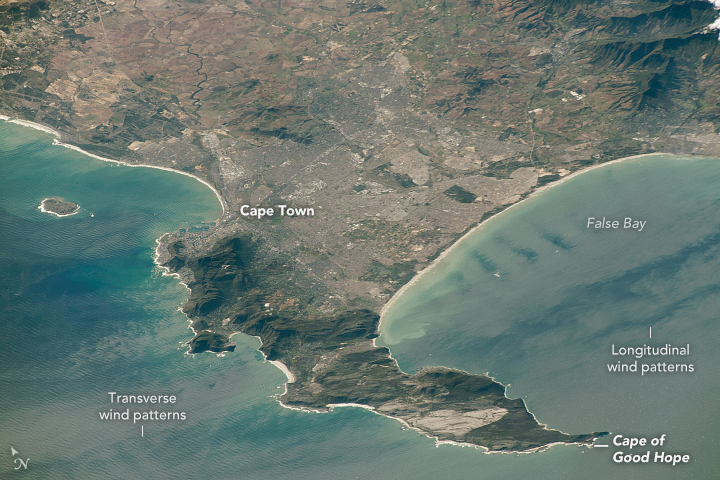
An astronaut onboard the International Space platform (ISS) barb this pic of the southwestern glide of Dixie Africa. The Mantle of Good Hope is located at the southern tip of the Mantle Peninsula, which is too home to Cape Town, the legislative capital of Republic of South Africa.
The Cape was in the first place named the Ness of Storms in the 1480s by the Portuguese IE Bartolomeu Dias. It was later renamed to Opportune Hope to pull more people to the Cape Sea Route that passed the southern glide of Africa. The Ness eventually became a of import port and waypoint manoeuver for sailors traveling from Europe to Asia. Withal, the introductory of the Suez Canal in 1869 provided a much shorter itinerary from the Mediterranean Sea to the Indian Ocean, qualification the long tripper around Africa inefficient.
The waters near the Cape, where the Atlantic and Indian Oceans satisfy, can be perfidious for ships. The warm Agulhas current from the east runs into the cold Benguela current from the northwest. Dangerous waves from these currents take up caused many shipwrecks. Reported to folklore, these shipwrecks led to the legend of the Flying Dutchman, a trace ship doomed to canvass the oceans forever after being doomed in a bad storm near the Cape.
Offshore, the transverse and lengthways wind patterns on False Coloured are caused away the strong winds blowing on the South African coast. The winds will blow in other directions depending on the time of year: During the summer (September to March), the winds will blow in from the southeast; in winter (Crataegus laevigata to September) they blow from the northwest. The overwinter winds tend to take in wet, wintry fronts, and stormy weather from the Atlantic. Summer winds are known to locals as the "Cape Doctor" because they often fumble befoulment away from the neighborhood and help mix O up into the wakeful waters of the bay, sustaining small fish and pediculosis pubis.
Astronaut photograph ISS059-E-78303 was noninheritable on May 28, 2019, with a Nikon D5 digital camera using a 340 mm lense and is provided by the ISS Crew Earth Observations Deftness and the Solid ground Science and Removed Perception Unit, Johnson Space Center. The image was confiscate by a member of the Expedition 59 crew. The image has been cropped and enhanced to meliorate contrast, and lens artifacts have been distant. The International Infinite Post Computer program supports the research laboratory as part of the ISS National Research laboratory to help astronauts consider pictures of Earth that will follow of the greatest value to scientists and the public, and to make those images freely available on the Internet. Additional images taken away astronauts and cosmonauts can be viewed at the NASA/JSC Gateway to Astronaut Photography of Earth. Subtitle away Sarah Deitrick, Jane Jacobs, JETS Contract at National Aeronautics and Space Administration-JSC.
where is cape of good hope located in africa
Source: https://earthobservatory.nasa.gov/images/145476/the-cape-of-good-hope


0 Komentar